
Abstract: Ghana stands as a beacon of stability and democratic governance in a region historically plagued by political instability and economic volatility. This paper provides a comprehensive analysis of Ghana’s contemporary economic and political status within the West African sub-region. It argues that Ghana’s role is dual-faceted: it is both a democratic anchor and an economic bellwether, whose successes and challenges reflect and influence the broader trajectory of the Economic Community of West African States (ECOWAS). The research synthesizes data from international financial institutions, regional bodies, and political analyses to examine the foundations of Ghana’s influence, its current economic tribulations, and its complex role in regional security and diplomacy.
1. Introduction: The Gold Coast Legacy
Ghana’s significance is rooted in its historical precedent as the first sub-Saharan African nation to gain independence (1957), its symbolic leadership under Kwame Nkrumah, and its subsequent traumatic cycles of military coups and democratic experimentation. Since the successful transition to the Fourth Republic in 1992, Ghana has constructed a resilient multi-party democracy, holding eight peaceful transfers of power (including two between opposing parties). This political stability forms the bedrock of its regional status, contrasting sharply with the recent wave of coups d’état in Mali, Burkina Faso, Niger, and Guinea.
2. Political Status: The Democratic Anchor
Ghana’s political capital in West Africa is immense and derives from several key pillars:
-
Institutionalized Democracy: Ghana boasts strong, albeit occasionally contentious, democratic institutions: an independent Electoral Commission, a vibrant and free press, a fiercely independent judiciary (exemplified by its role in adjudicating electoral disputes), and a robust civil society. The “Ghanaian Model” is frequently cited as an aspirational benchmark for the region.
-
Soft Power and Diplomacy: Ghana is a consistent contributor to ECOWAS and African Union peacekeeping missions. Its diplomacy is characterized by active mediation, as seen in its roles in the Gambian crisis (2016-2017) and attempts to engage with the juntas in the Sahel. Accra is also a hub for pan-African intellectual and cultural discourse, reinforced by the symbolic return of the African Continental Free Trade Area (AfCFTA) Secretariat to Ghana in 2020.
-
Contrast with Regional Instability: In the wake of the Sahelian coups (2020-2023), Ghana’s stability has become even more strategically valuable to international partners (the US, EU, and UK) and ECOWAS. It is often the leading voice advocating for democratic restoration and constitutional order, positioning it as a counterweight to anti-Western and pro-Russian narratives emanating from military regimes.
3. Economic Status: From Star Performer to Debt-Restructuring Pioneer
Ghana’s economic journey is a tale of rapid growth, profound structural challenges, and recent severe distress.
-
Historical Growth and the “Ghana Miracle”: From the early 2000s to approximately 2019, Ghana was one of the world’s fastest-growing economies, propelled by political stability, significant inflows of foreign direct investment (FDI), and the commercial exploitation of oil (beginning 2010). It achieved Lower-Middle-Income Country status in 2011. Its GDP consistently ranked among the top five in West Africa.
-
Structural Vulnerabilities: Beneath the growth figures lay chronic vulnerabilities: 1) Fiscal Deficits: Persistent high budget deficits driven by large public sector wage bills, energy sector subsidies, and pre-election spending. 2) Debt Sustainability: Rising public debt, exacerbated by exposure to volatile commodity prices (gold, cocoa, oil). 3) Import Dependency: A reliance on imported goods (food, pharmaceuticals, manufactured goods) makes the economy highly susceptible to currency depreciation and global supply shocks.
-
The Perfect Storm and IMF Bailout (2022-Present): The confluence of the COVID-19 pandemic, the Russia-Ukraine war, and domestic fiscal slippage triggered a profound crisis in 2022. Inflation soared past 50%, the Ghanaian cedi was among the world’s worst-performing currencies, and foreign reserves dwindled. In July 2023, Ghana secured a $3 billion, 3-year Extended Credit Facility with the IMF—its 17th program.
-
The Bellwether Role: Ghana’s crisis and its subsequent handling have regional implications. It became the first African nation in the COVID-era to default on its external debt and enter into a comprehensive debt restructuring under the G20’s Common Framework. The outcome of this painful process—involving bilateral creditors (China Club, Paris Club) and private Eurobond holders—is being closely watched by other distressed economies (like Zambia and Sri Lanka) as a test case for the international financial architecture.
-
Economic Strengths and Future Potential: Despite the crisis, Ghana retains fundamental strengths: 1) Natural Resources: It is the world’s second-largest cocoa producer and Africa’s largest gold producer. 2) Strategic Sectors: A growing services sector, particularly in fintech (e.g., MTN’s mobile money dominance) and a relatively diversified base compared to neighbors. 3) AfCFTA Hub: Hosting the Secretariat positions Ghana to potentially attract intra-African investment.
4. The Interplay of Politics and Economics: Challenges to Hegemony
Ghana’s status is not unchallenged, and its political and economic spheres are deeply intertwined:
-
The Democracy-Development Paradox: Public frustration over the severe economic hardship (“the cost of living crisis”) poses the most significant threat to Ghana’s democratic consensus. While citizens value stability, economic distress tests their faith in the democratic model, especially as junta-led neighbors blame Western-style democracy for their woes.
-
Regional Rivalries and Leadership: Nigeria’s sheer economic size inevitably overshadows Ghana. Tensions surface periodically, such as trade disputes leading to border closures (2019-2020) under the guise of enforcing ECOWAS protocols. Ghana’s leadership is sometimes perceived as overly aligned with Western interests by Sahelian states.
-
Security Spillover: The instability in the Sahel presents a direct security threat. Jihadist violence is encroaching from Burkina Faso into northern Ghana, forcing Accra to increase military spending and engage in delicate cross-border diplomacy, balancing counter-terrorism with maintaining regional relationships.
5. Conclusion: An Imperfect but Indispensable Leader
Ghana’s status in West Africa is that of an imperfect but indispensable regional power. Politically, it remains the most credible advocate for democratic norms and peaceful conflict resolution in ECOWAS. Economically, it is a cautionary tale and a laboratory for resolving sovereign debt crises, its recovery vital for regional economic confidence.
Its future influence hinges on its ability to navigate its immediate economic restructuring successfully, manage internal social pressures, and craft a nuanced diplomatic approach that bridges the divide between coastal democracies and Sahelian military regimes. Ghana’s journey demonstrates that democratic resilience is a continuous struggle, not a permanent achievement, and that economic sovereignty is the critical foundation for lasting political stability. For West Africa and its international partners, a stable and prosperous Ghana is not just a Ghanaian interest, but a fundamental regional necessity.
References:
-
World Bank. (2023). Ghana Country Economic Memorandum.
-
International Monetary Fund. (2023). Ghana: Requests for an Extended Arrangement Under the Extended Credit Facility.
-
Gyimah-Boadi, E., & Prempeh, H. K. (2021). “Ghana’s Democracy: A Bright Yet Imperfect Beacon.” Journal of Democracy.
-
ECOWAS Commission. (Various). Communiqués and Protocols.
-
African Development Bank. (2023). West Africa Economic Outlook.
-
Whitfield, L. (2018). “The Politics of Industrial Policy in Ghana.” In The Politics of African Industrial Policy.
-
BBC, Reuters, & African Arguments – Contemporary news analyses on debt restructuring and regional politics.
-
Ghana Statistical Service. (2023). Consumer Price Index Reports.
-
REGION CAPITAL AHAFO GOASO ASHANTI KUMASI BONO EAST TECHIMAN BRONG AHAFO SUNYANI CENTRAL CAPE COAST EASTERN KOFORIDUA GREATER ACCRA ACCRA NORTH EAST NALERIGU NORTHERN TAMALE OTI DAMBAI SAVANNAH DAMONGO UPPER EAST BOLGATANGA UPPER WEST WA VOLTA HO WESTERN SEKONDI-TAKORADI WESTERN NORTH SEFWI WIASO -
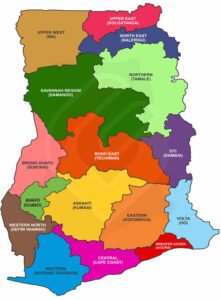
Ghana-Regional
Related Posts
The Economic and Political Status of Uganda
Abstract This paper examines Uganda's contemporary economic and political status…
The Economic and Political Status of Rwanda in East Africa
Abstract This paper examines Rwanda's contemporary economic and political status…
The Blue Economy and Political Status of Seychelles
Abstract This paper examines Seychelles' contemporary economic and political status…