 |
||||||
|
||||||
| Swahili | ||
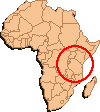 |
Location | Coastal Kenya, Tanzania |
| Language | Kiswahili (Bantu) | |
| Neighbours | Mijikenda, Zigua, Doë, | |
| Kwere, Zaramo, Makonde | ||
| Types of Art | ||
| Swahili art forms are limited to architecture, furniture, and personal adornment. The great carved wooden doors of the coast are displayed as a sign of wealth. | ||
| History | ||
| The inhabitants of the coastal areas of Kenya, Tanzania, and Mozambique share history, language, and cultural traditions, which some Swahili scholars claim date to at least 100 A.D., when an anonymous Greek traveler and author of The Periplus of the Erytharaean Sea wrote about a place in east Africa, which Arabs frequented to trade with those living on the mainland. This history is closely tied to Indian Ocean trade routes linking India, the Arabian Peninsula, and Africa. Despite the shared history and language of the peoples of the Swahili Coast, it remains difficult to describe a discreet Swahili culture. This is not to suggest that a Swahili culture does not exist, but instead that its boundaries are amorphous, changing whenever necessary to meet the demands of everyday life. | ||
| Economy | ||
| Swahili economy today, as in the past, is intricately linked to the Indian Ocean. For approximately 2,000 years, Swahili merchants have acted as middlemen between eastern and central Africa and the outside world. They played a significant role in the trade of ivory and enslaved peoples which climaxed during the 19th centuries. Trade routes extended across Tanzania into modern day Zaire, along which goods were brought to the coasts and were sold to Arab, Indian, and Portuguese traders. Many slaves sold in Zanzibar ended up in Brazil, which was then a Portuguese colony. Swahili fishermen still rely on the ocean to supply their primary source of income. Fish is sold to their inland neighbors in exchange for products of the interior. | ||
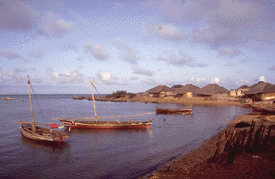 Swahili Fishing Village
 |
||
|
The word "Africa" origins from Latin and Greek.
Originally it only described the area today known as Tunesia, but
eventually it became a name for the whole continent. This could be one
of the reasons of the (still) common misunderstanding that Africa is
one, uniform "country". Truth is that more than 1,500
different languages are still spoken in Africa -and the many people of
Africa has very different histories and culture. |
||
| The Swahili Culture | ||
| Often
people ask us the difference between the Swahili people and culture; we
have often responded with the answer "you mean, the Kiswahili
language and the Swahili people"! The Swahili word is an easy
alteration of the Arabic word called Sawahil, meaning coastal. The
Swahili culture came about from the inter-marriage of the African
Bantu's and the settler Arabs starting before or around the 12th
century. The language that rose from this cultural mix was Kiswahili.
The Tanzanians, specifically Zanzibaris, or the Swahili people prefer to
boast about their authenticity of the Kiswahili language, pronunciation
and grammar in comparison with the others. The original Swahili people
can be found on the East African coast at places like Mombasa, Lamu,
Zanzibar, Pemba, and Malindi. However, the preservation of the original
culture is easily found in Lamu and Zanzibar, on the decline though. Swahili people are not Arabs. They are more African if anything else but they tend to gravitate towards the paternal culture and religion, Arabic and Islam. Their look and feel is very Arabic. The men are often seen "hanging" out in their barazas (bench or sitting place), sipping their Kahawa (strong Arabica coffee), and clad in their traditional Khanzu (white gown) and Kofia (prayer hat). The women can be often seen scurrying around town in the bui-bui's, walking across from shopping centers or friends homes. The Swahilis are assumingly, a friendly culture. Their friendly gestures of "Hujambo", "hallo hallo", "vipi", "mambo", "story" and "leta habari" can easily be overhead across from the serpentine alleys of Mombasa, Zanzibar, and Lamu; these are various ways that their daily salutations are presented. In the 17th and 18th century, the strength of the Swahili population was increased by the continuous arrival of large ships for trade purposes. Everything possible in that period was traded e.g. cloves, spices, ivory, slaves, mangrove poles, silk, and wares. Trading become such an integral part of coastal islands, Zanzibar, Malindi, Mombasa and Lamu, that Seyyid Said, the Omani Sultan, in 1844 moved his capital to the Island of Zanzibar also called the Spice Island. Commerce continued to thrive, especially when even larger European ships carrying famous dignitaries like Dr. David Livingstone stopped over. The large and deep see ports of Mombasa and Zanzibar became easy targets of dilution of the beautiful Swahili culture, leaving behind Lamu, which is the prime example of true and authentic remainder of the Swahili culture. Lamu Island can be reached only through boat. Its preservation, or better put "stillness in time", is a must visit for everyone touring Africa. No place displays a better example of friendliness, awesome antiquated architecture, deep prevalence of a traditional and beautiful culture, and religious practices e.g. A donkey carrying passengers on its back, older gentlemen sitting on the corner of a mosque waiting for the muezzin to recite the call to prayer, children running the streets, vendors selling fresh organic machunguas (oranges). Lamu's economy for the locals of the town is minimal. There are street hawkers selling fruits and vegetables, few stores selling grocery brought over from the mainland, fishermen on the edge of the harbor bringing in their daily catch, and tourism. The hey-days of the earlier centuries, where the swampy and marshy areas produced abundant amount of the mangrove plant are over. The mangrove was resistant to rust, rote and bugs, which made it an ideal item for building ships. Tons of trees were cut down, almost making the regional area barren; the cutting of the mangrove plant is now prohibited. The most fascinating experience of the culture and religious activities, which inherently boosts the local economy, comes from the Maulidi event. The Maulidi is a mark of the birth date of the Prophet of Islam. The event consists of musical events of taarab (a mixture of Swahili prose, poetry, and dance), singing, food distribution, prayers, and a procession to the local cemetery. A whole parade of onlookers, including people from different parts of the world, comes to visit this almost mythical event. Most visitors are in awe during this superb event, which gets reported by various newspapers around the globe. Lamu's peacefulness and serenity brings unmatched excellence for any visitor. The tourist lodging provided through AfricanMecca, Inc. is perfect for all who want to enjoy relaxation time as well as enjoy a cultural learning experience. |
||
| Zulu | |
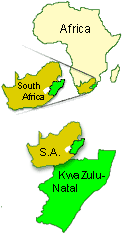 |
Located in the Natal Province in South Africa |
| Population of about 3 million | |
| Neighbours include Sotho, Tswana, San | |
| Language is Kwazulu (Nguni) | |
| Types of Art | |
| The Zulu are best known for their beadwork and basketry. There have also been some figural sculpture questionably attributed to them. Zulu architecture is quite complex, and the dress or fashion of the Zulu has been carefully studied. | |
 Zulu Dancer
 |
|
| History | |
| The AmaZulu believe that they are the direct descendants of the patriarch Zulu, who was born to a Nguni chief in the Congo Basin area. In the 16th century the Zulu migrated southward to their present location, incorporating many of the customs of the San, including the well-known linguistic clicking sounds of the region. During the reign of King Shaka (1816-1828), the Zulu became the mightiest military force in southern Africa, increasing their land holdings from 100 square miles to 11,500. Shaka was followed by Dingaan, who tentatively entered into treaties with English colonizers. Mpande was the next King. He allowed the British extensive control over his peoples. By the time he died in 1872, the Zulu had had enough of the English invasion. Cetewayo, Mpande's replacement, tried vainly for six years to avoid a confrontation with the British, yet in 1879 war erupted. Although the Zulu initially experienced some success, the British army eventually prevailed. In less than six months, Cetewayo was exiled to England, and the Zulu kingdom was divided to the British advantage. The last Zulu uprising against European domination was lead by Chief Bombatha in 1906. In recent times, Chief Gastha Buthelezi has doubled as the political leader of the Zulu, and the head of the Inkatha Freedom Party, leading the fight against Apartheid and the ANC, demanding a voice for his people who are more than three million strong. | |
| Economy | |
| Rural Zulu raise cattle and farm corn and vegetables for subsistence purposes. The men and herd boys are primarily responsible for the cows, which are grazed in the open country, while the women do most, if not all, of the planting and harvesting. The women also are the owners of the family house and have considerable economic clout within the family. In the urban areas of South Africa, Zulu, and in fact all Africans, are limited to labor intensive work and domestic duties. Even as Apartheid as an institution has been dismantled, it is still extremely difficult for Africans to compete for jobs for which they have not been trained, and the country is still entrenched in de facto racism. | |
| Zulu - Reed dance; a cultural event | |
 |
|
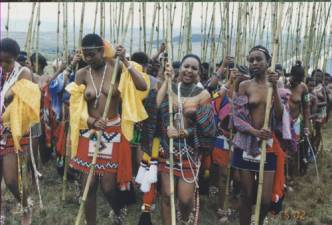
| Women participating in the reed dance | |
| Thousands of Zulu virgins converge at the Enyokeni Zulu Royal Palace in September every year to celebrate the Umkhosi woMhlanga (Reed Dance Festival). The Reed dance is an activity that promotes purity among virgin girls and respect for young women. The festival is part of the annual festivities on the calendar of the Zulu nation. During the Reed dance the virgins fetch the reeds from the river and bring them to the palace for the royal king, King Goodwill Zwelithini to inspect. It was during this festival that the Zulu King chose his youngest wife. Some people criticize this festival, claiming that it disempowers young women who may be made wives at an early age without being given a choice to chose the husband that they like. But to many, this ceremony helps to preserve the custom of keeping girls as virgins until they get married. | |
|
copyright ©2002-2003 afritopic.com |
